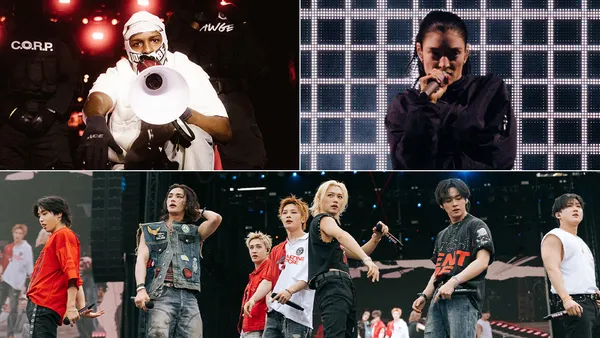
The weather is warm, the nights are cool, the food is unbelievable, and the passion is palpable. This is what the beloved Mexico City festival Corona Capital brings to the table each November. This year’s edition, which went down November 14th through 16th, served as the festival’s grand 15th anniversary celebration, and they pulled out all the stops: Foo Fighters, Chappell Roan, and Linkin Park topped the bill, with fellow headlining performances from the likes of Queens of the Stone Age, Deftones, Vampire Weekend, Weezer, Franz Ferdinand, and more.
At Corona Capital, it’s challenging not to indulge in nostalgia. As they’ve done every year, the organizers are happy to bring treasured acts of yore to the festival’s five stages; this year, that strategy led to performances from ’90s and 2000s rock heroes, 2010s indie favorites, and a ton of acts in-between.
But like any great festival, Corona Capital can’t ignore the way the music landscape has changed on a global and a regional level since their inaugural edition in 2010. So to help Corona Capital stand out amidst the When We Were Youngs of the world, they secured some strong of-the-moment showcases and current touring stalwarts like Men I Trust, Adéla, Nilüfer Yanya, Polo & Pan, Lucy Dacus, and the aforementioned Chappell Roan.
Despite a few cancelled sets, the festival ran smoothly and the vibes were high. There’s a ton to see and experience at Corona Capital for local and international fans, so here’s a rundown of what made this year’s festival a memorable celebration of Mexico City and music’s past and present.
— Paolo Ragusa
Live Music Editor
Indie Rock Royalty
Having Foo Fighters, Queens of the Stone Age, Deftones, and Linkin Park on the top lines suggests that Corona Capital is a capital R-rock festival through and through (on par with the recent Danny Wimmer Presents festivals like Aftershock or Louder Than Life), but in Mexico, the barriers between harder, mosh-friendly rock and softer strains of indie are pretty much non-existent. That led to a lineup that was guitar-forward but still very balanced; being able to rock out at one set and be calmly wistful at the next is becoming less and less common at American festivals, and Corona Capital’s insistence on bringing these various rock styles under one festival umbrella is one of its strong suits.
This year, they nabbed three out of four of the big 2025 indie rock reunions: Grizzly Bear played an outstanding golden hour set on Saturday, Alabama Shakes followed that evening, and TV on the Radio made a scorching, heartfelt return on Sunday (for what it’s worth, the only reunion they missed was Rilo Kiley, which would have been a perfect addition). These three acts each emerged from a similar era of indie that was as thoughtful as it was riveting, and their respective sets were welcomed warmly throughout the weekend.

TV on the Radio, photo via OCESA
While Alabama Shakes were unfortunately pitted against fellow indie favorites Vampire Weekend on Saturday night, the organizers’ insistence on spotlighting the genre’s breakthrough era made these shows feel more celebratory; bands like Real Estate, Cut Copy, and Franz Ferdinand played extended sets that showed just how well their music has aged over the last decade-and-a-half. Grizzly Bear in particular have quite the deep catalog, and they opted for some spellbinding cuts that captivated and enchanted. — P. Ragusa
Remember When?
As stated, nostalgia is a significant currency at Corona Capital. Some throwback acts have kept their momentum and aged extremely well. The great post-rock band Mogwai are certainly one of them. Deftones too, and they played a hefty amount from their new album private music. Marina, who could have so easily been relegated to “Remember the Tumblr era?” status, has also kept up her hot streak; though she played on a stage that was way too small for the thousands that came to see her instead of Norwegian pop star Aurora, Marina’s Princess of Power cuts are some of her best songs yet.
But having to face so much nostalgia against new and novel acts like Chappell Roan creates some tension. That tension was the most apparent on Sunday night with Linkin Park’s headlining set. It’s not like they played poorly or didn’t bring the energy (new vocalist Emily Armstrong has an absolutely gigantic instrument and can really let it rip), but they really wanted the occasion to celebrate their new, post-reunion album From Zero instead of their Chester Bennington-rooted back catalog.
Look, I won’t blame a band for wanting to champion their new material in a headline show. But doing nine songs from From Zero and omitting classics like “Breaking the Habit” and “Crawling” — two of Bennington’s most heartbreaking contributions — made the headline set feel incredibly lopsided.
What it really does it put a spotlight on why their new stuff doesn’t hit nearly as hard compared to the Hybrid Theory and Meteora tracks. It shows that Mike Shinoda and co. are happy to keep turning the same dial that they had before Bennington passed, and unfortunately, very little of their 2010s catalogue holds up. Did they really need to do an uninspired slog like “Burn It Down” instead of “Crawling”? They didn’t, but across the board, it seems like Shinoda can’t help himself from indulging. This new Linkin Park era has some small improvements on the formula, but regardless of how great Armstrong sounds, the unfathomably boring From Zero simply hasn’t earned the band the privilege to ignore why so many gravitated to Linkin Park in the first place. — P. Ragusa
Deftones: A Legacy Still in Motion
One of Corona Capital 2025’s highest peaks was Deftones’ explosive set, a performance that proved there’s no barrier to feeling Chino Moreno’s voice surge through every nerve. The set brought together devoted Gen Z, Millennials, and Gen X fans, and as you’d expect, the performance was a visceral experience. Deftones have always communicated in a language that exists somewhere between sound and sensation — the dense, lacerating riffs, the atmospheric haze, the sudden soft edges that make you brace for impact.
For Mexican crowds, that alchemy becomes a mirror. People don’t just listen to Deftones; they inhabit the songs, letting the tension, release, and emotional volatility wash over them like shared memory. It’s a communion rooted in the feeling that every whisper, every scream, every dynamic in their music reflects something deeply familiar.
Deftones’ impact on Mexican audiences runs deeper than a trend or viral moment. Chino’s emotional resonance and the way his voice threads through the band’s lyrics taps into a distinctly Latin sentiment: one that loves, suffers, screams, and above all, evolves. In that space, Deftones are more than a headliner. They become a conduit, a place where thousands of people can recognize themselves in the noise and find clarity in the chaos. — Jorge Diaz
We’re So Lucky to Have Chappell Roan
Chappell’s new “Visions of Damsels and Other Dangerous Things” shows are a victory lap of all victory laps. It was special to witness the transformative power of her act in real time, and the fact that it was her first-ever performance in Mexico City made it even more emotional. There were people of all ages that had waited for years to bear witness; it was also particularly heartwarming to see Mexico City’s queer community show up in droves on Saturday, helping foster a more utopian festival environment where free expression is celebrated.

Chappell Roan, photo via OCESA
Though she admitted to being quite nervous to bring such pop-centric fare to a festival brimming with rock, her new beefed-up, glammy, highly-theatrical show is a rock and roll show. Now with the opportunity to close out this Midwestern Princess era, she’s remade herself into a rock goddess, howling over metallic guitars, heightening the songs’ arrangements, and belting out Heart’s “Barracuda” like she wrote the damn song herself. In fact, no one really epitomized Corona Capital’s hybrid style (the combination of past and present, of rock and pop, of passion and restraint) like Chappell. — P. Ragusa
Limited Local Fare
Corona Capital’s predominately Western lineup is certainly appealing given how rare it is for these acts to play Mexico, but year after year of this approach does eventually feel a bit limiting. If there’s one lingering critique of Corona Capital, it’s the continued absence of Mexican and Latin American acts. We can only hope that future editions tap into the regional projects currently reshaping the musical landscape, offering inspiration to all of us who flock to festivals searching for a sense of direction. For the sake of the culture and the community, we long for lineups that spotlight the creativity and musical brilliance of the new generation, artists who too often go unheard within the country’s massive stages. — J. Diaz
They Weren’t Kidding About the ‘Corona’ Part
Corona Capital is a music festival. And as its title suggests, even beyond simple branding purposes, Corona Capital is also a beer festival. Never have I been to a festival where beer is so readily available and for such a low cost — a massive cup of Corona for less than $10 US dollars is egregious to the Mexican fans, but to my inflation-addled American brain, that’s cheap (at Lollapalooza or Coachella, that beer costs $16 in 2025). If your cup was empty, no matter how deep or far in the crowd you were, all you had to do was wait about 30 seconds and a vendor would be crossing through your section with cervezas. — P. Ragusa
Those Pesky Little Phones
Having attended Corona Capital for the first time, I learned a lot about why Mexico City’s music scene is growing faster than ever, and why the passion these fans feel towards their favorite artists is worth celebrating. But there was an aspect to this festival’s fan and audience culture that I could not ignore, and that was the amount of attendees filming 60% to 90% of the shows on their phones.
I don’t bring this up to be holier than thou or deride attendees — it’s something we all do, and it’s a fixed aspect of the concert experience in 2025 pretty much everywhere around the world. The way I understood it, this urgent need to capture these moments comes from the fact that artists don’t tour through Mexico as often as they do in, say, the US or the UK. For many fans at Corona Capital, the passion they felt for these artists and the popular songs they wielded was, in a weird way, shown through a sea of people’s phones, attempting to capture a musical moment that they may not receive again until Corona Capital 2029 or later.
Still, there comes a point when the need to pull out your phone and press record becomes a substitute for actually letting go and enjoying the moment. Again, this is not ‘old man yells at cloud,’ and it’s perfectly fine and fun to get a video of Franz Ferdinand doing “Take Me Out” or Chappell Roan letting it rip during “Good Luck Babe.” But the amount of phones I saw during moments that deserved a present, enthusiastic audience — which is synonymous with the type of energetic, belt-all-the-words passion that Mexican music fans are known for having — was a little concerning.
It’s not just at this festival, and it’s challenging to imagine it changing any time soon. The solution might have to come from artists who deliberately encourage the audience to put their phones away just for a song or two. It’s amazing to look back on concert memories and revisit the great clips you captured, but being present and united with that artist, in that moment, is undeniably more precious. — P. Ragusa
Special Details and Unique Offerings
Corona Capital offers some personalized touches to the festival experience that helps foster a unique identity. For one, there’s the food selection, which mirrors Mexico City’s diverse and inspired offerings on street corners, bars, and alleyways. Even the drinks were unique to the region. I ordered a margarita and saw them mixing a black syrup in it, so I looked it up — turns out it’s something very common called chapulín syrup, which is syrup blended with roasted, ground-up grasshoppers.
One of the other rewarding and inspiring aspects to Corona Capital is the production design of their stages. The main stage, the Doritos stage, and the Corona Sunsets stage each had custom-designed frames around them, and they looked incredible. More festivals should embrace the fact that stages are not merely a frame around an artist’s performance — they can be art themselves, and help complement and add to the performance.

Lucy Dacus, photo via OCESA
There were countless touches like these that help bolster Corona Capital’s identity and status. With an increased emphasis on sustainability and inclusion, the festival successfully rivals America and Europe’s biggest events, and it’s only getting bigger. The grand, multi-genre festival dream is still alive at Corona Capital. Though their lineups could use a bit more of an emphasis on music’s globalized future (as in, a few more left-of-center or non-English acts), they have unified a city and its visitors with kindness, inclusion, joy, and great music — proving that in Mexico City every November, the past and present can coexist beautifully under one banner. — P. Ragusa