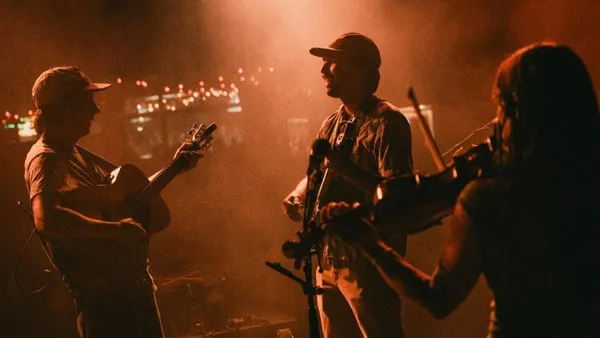
Track by Track is our recurring column that sees artists take readers through each song on their newest release. In this edition, Jesse Welles explores his new album, Masks Off.
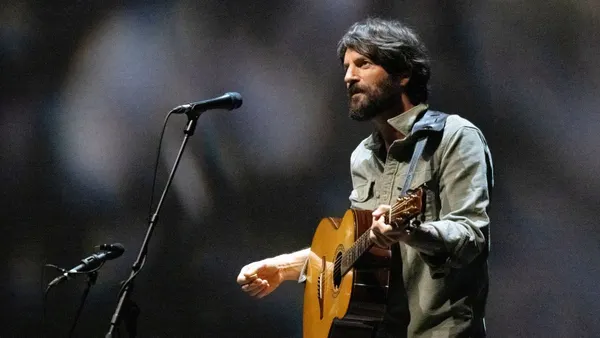
Over the last couple years, Ozark, Arkansas-based folk singer Jesse Welles has broken through the public sphere with poignant and raw storytelling that speaks to the collective unrest in society and the political landscape. His form of musical protest is straightforward, and often with a hue of satire. Welles’ ability to authentically tell it how it is through his 21st century lyrics in a genre that has historically been a vessel for truth is exactly what’s resonated so deeply with listeners.
Despite the growing fame, Welles’ intention with his music hasn’t faltered one bit on his sixth studio album Masks Off. With his trusted producer Eddie Spear, Welles cut the album in three sessions in the midst of touring to create an album that draws from some of the most pressing political and social issues plaguing the country, from ICE to DOGE. Back in May, Welles released the album’s opening title track, which we recently named as one of the Best Songs of 2026.
Without attempting to dictate how people think, Masks Off is purely a sincere and introspective reaction to the world around Welles. He suggests that everyone’s intentions are out in the open, and nobody is hiding behind a facade anymore. Hate is not only exposed, it’s encouraged. Welles reckons with this in real time through this album, balancing earnestness with humor, capturing a collective attitude and reaction to the moment we are living through.
Masks Off is now available to stream below, followed by Welles’ Track by Track breakdown.
Jesse Welles also has a number of tour dates throughout North America from July to October. Grab tickets to see him in concert here.
“Masks Off”:
It’s the culmination of the I.C.E. surge in Minnesota, the abduction of Venezuela’s leader, and the post-D.O.G.E. world where we’re realizing the masks are off and they’re doing things in broad daylight without caring. Hate is out in the open, it’s permissible, and it’s encouraged. When we recorded it, I had gotten a new guitar at Carter’s in Nashville. I told Eddie, “Let’s get a Marshall stack and fucking blow this up with electric guitar.”
“The Ballad of Big Balls”:
It’s like a lot of those blues tunes from the sixties. I missed the news for a week, and “The Ballad of Big Balls” came out of me catching up. There was quite a lot of distraction from the Epstein files. Something was going out with Cracker Barrel. I don’t even remember what that was, but the news can be so dumb. Throughout the song, we touch on how the NRA lobbies. We touch on Mike Huckabee who’s a disgrace to Arkansas. We bring up Alex Jones who said frogs are gay. There’s also Peter Thiel’s protégé — “The Thiel-ian Prince” — otherwise known as JD Vance. The tune is a bit of mess, but there’s a lot of fun in there. I called it “The Ballad of Big Balls” because they hired this kid nicknamed “Big Balls” for D.O.G.E. He got tangled up in some bullshit in DC, and he got his ass whooped. I got a big kick of that.
“Everything Must Die”:
I had been listening to a lot of Oasis. I just wanted to write a song for myself that could also be palatable to other people. I don’t want to be the same artist forever. I don’t want to be stiff and unwavering. I’d rather be soft, fluid, and able to move through genres and styles. I’d like to find what other people need from me. If you make art, that’s the job. Lyrically, I’m sort of talking to myself. I’m asking, “How does it feel to be seen? This is all you ever wanted, and now it’s here.” You realize things have actually changed, and it’s okay because everything has to die. The song can be a eulogy for old life, while also welcoming new life. In my heart, I believe exchange is good and constant. You should embrace it, roll with it, and be flexible and adaptable. “Everything Must Die” tries to capture the bittersweet failing of change.
“Technopagans”:
It gets at the sudden surge in religiosity in Silicon Valley. Thiel got out in front of it, doing lectures across the west coast on the antichrist and declaring anyone with environmental sympathies (Thunberg, etc.) a luddite and antichrist. To question unrestrained exponential technological growth has been basically outlawed. By allowing technology to grow at a rate faster than human cognizance, we’re speeding into the unknown. There will not be any going back.
“Meet the New Swamp”:
These factions came together in order to push this administration over the line and into the Oval Office. Once they got settled into the party, the same individual factions began to look around at one another. They realized they weren’t quite as similar as they thought they were, and the in-fighting began. With “Meet The New Swamp,” I’m basically getting at the fact mom and dad are now fighting.
“Siddhartha”:
Eddie gave me the book Siddhartha as a gift. This is my book report. In life, we experience some form of the steps Siddhartha goes through to become enlightened, and it’s never what you think it is.
“Won’t You Come Out Tonight”:
“Won’t You Come Out Tonight” started as a poem in Colorado. It’s been good to get out and travel, because touring has inspired new songs. Otherwise, I wouldn’t have been in Estes Park on Halloween. All of these trick-or-treaters were out, the shops were closed, and there was a big parade down the main street. It reminded me of being a kid back in my mountain town. I essentially wanted to capture what it was like to grow up in a small U.S. mountain town with a tune.
“Domestic Error”:
I made this in December 2024. It’s similar to “The Ballad of Big Balls.” It was my “State of the Union” address for the moment. Unfortunately, the same cycles repeat over and over again. It’s just Shakespeare in new costumes.
“Red”:
Some subjects are too heavy to talk about straight on, so it’s best to talk about them with a sense of humor and a bit of a smile. “Red” happened in 2025 after I’d just come home from a European tour. I’d say it’s another “State of the Union” song about the world at the time.
“Join ICE”:
“Join ICE” explores the psychology of anyone who’s ever been picked on. It says, “Join the bullies. Join the bad guys.” It’s compelling folks to try to put themselves in a position of pseudo-authority. What would you have to lack in your own life to want to go and terrorize someone else’s life? This is the list of things you’d have to lack that I came up with.
“This and Not Some Other Way”:
When I was ready to record, I pulled my van over to the side of the dirt road in Siloam Springs between two cow pastures, took my tripod out, and played it on the bumper of my van. Lyrically, it covers a lot of ground. I guess it’s a song about being me.”