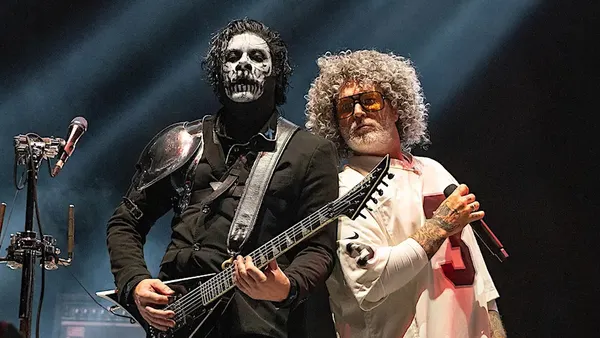
Limp Bizkit‘s Wes Borland has teamed up with Jackson for his own King V KV guitar, marking his first-ever signature collaboration with the company.
The stylish guitar, which retails for $1,299.99, boasts a Seymour Duncan Invader bridge pickup, 1-piece maple neck-through construction with graphite reinforcement, a compound radius ebony fingerboard, 24 jumbo frets, a recessed Floyd Rose 1500 series bridge, and other features.
Buy a Signature Wes Borland Jackson King V KV via Reverb
“It’s taking me a long time to figure out what I need as a guitar player. For me, you just need volume, pickups, locking tremolo system and 24 frets, that’s it,” stated Borland. “Live, it just needs to be as bulletproof as possible. You know, I’ve been very rough with guitars over the years.”
He added, “I’ve come to realize that the more streamlined our guitars are, the less problems we have on stage… You know Jackson is fun, the over the top, shred-a-copter shapes and my outrageous stage costumes pushing the boundaries, this fits in more with that. The way people dress, it affects how you behave, and I think it also changes how I play guitar.”
Heavy Consequence caught up with Borland to discuss his signature King V KV, as well as memories of his first-ever guitar and the musicians who influenced him when he first started playing.
Pick up a Wes Borland King V KV guitar via Reverb, and see more specs at the Jackson website. Check out our interview with the Limp Bizkit guitarist below.
What is it like for you to get your first-ever Jackson signature guitar, and what was the inspiration behind it?
It’s kind of been a long time coming. I’ve been with Jackson for a long time, and Jackson’s main artist relations rep is a guy named Mike Tempesta, and he’s the American guitar rep. I was with him at Yamaha Guitars before I was with Jackson, and I had a signature model there. And then when he moved over to Jackson, I just followed him over and have been using Jacksons for a number of years. I always just loved them. I was a huge Megadeth fan as a kid, so seeing Dave Mustaine playing King Vs just put something in my head that I can’t ignore or get away from.
Little kid me just went, “Jacksons are amazing,” after seeing all those videos, especially the “Go to Hell” video with Marty Friedman, Dave Ellefson, and Dave Mustaine’s fretboards with the signature shark teeth inlays. During the solo section of that video, I was just like, “Jacksons, Jacksons, Jacksons, Jacksons.” I just thought they were such cool guitars. I just loved them so much. And when Mike went over to Jackson, it was just a sort of like a natural thing for me to follow him there, and we’ve been talking for years about doing a signature model.
Ross Robinson, who produced our first record, Three Dollar Bill, Y’all, he gave me, years ago, his first Jackson. It was an ’81 Randy Rhoads, and it’s still in my guitar vault today. For some reason, the Jackson just kept coming to me over and over again in different ways in my life.
So, I’m really just surrendering to fate, I guess, and going, “Well, I guess I’m a Jackson player now.” But around 2012 or 2013, this is after I’d been with Jackson for quite a while, Mike went, “Dude, there’s this reverse headstock King V that just came in that a customer had ordered, but they didn’t think the ebony on the fretboard was dark enough, so they sent it back.” And I was like, “What an asshole.” I was just like, “That’s such a little thing to be that picky about.”
But I guess if you’re buying a custom shop Jackson, you want the ebony to be ebony-ing and not rosewood-ing. But he goes, “Come on in. You can have it.” And I went in, and he opened the case, and he goes, “Oh, it’s a lefty. It’s not a reverse headstock.” And I went, “That’s not a problem.” And my tech and I took the guitar and made it a project to, like, switch the whole thing to be a right-handed playing guitar. And I just loved it.
For some reason, I just loved that guitar so much, and that’s what we based the signature model on. It’s a reverse headstock, and the Jackson is upside down on the headstock. It’s like a little tip of the hat to the left-handed King V that my tech and I converted to be right-handed.

What are your favorite features on the signature King V?
When I started playing guitar, one of my first guitars had a Floyd Rose on it, and I didn’t really have money to buy effects pedals, so I just really, as a beginning guitar player, started focusing on the Floyd Rose. What can I do with this? How can I move it around? How many different ways can I manipulate this amazing feature to emulate effects that I couldn’t afford? … It’s my favorite thing. I don’t play guitars that don’t have those on them normally, ’cause I use it so much.
But I think my tech and I also talked about what we didn’t want, what we didn’t need. We didn’t need multiple pickups. We didn’t need a tone knob. We didn’t need a bunch of bells and whistles [and] effects built into the guitar.
I just watched Jack White’s tech run down his new Fender that he’s had out for quite a bit of time now, and it’s loaded with all these magic tricks, and I was feeling badly the other day ’cause I was like, ‘We don’t have any tricks.’ We just did the simplest guitar possible. I kind of felt weird about that for a minute, and then was like, “No, that’s all we need. We don’t need extra things that could cause problems onstage.” So I [like] the streamlined part, 24 frets, Floyd Rose, one volume knob that’s way out of the way. I can’t stand guitars that have the volume knob right next to the pickup.
Do you remember your first ever guitar, and is there a story behind it?
My first-ever guitar was only really my first guitar for about a year before I moved on to a one that had a tremolo on it. So my first guitar, I grew up in Nashville for a time, it was a Infinox by JTG. It was a Humbucker Kelly knockoff. I mowed lawns, bought it for 80 bucks, and I had a 15-watt Gorilla amp that I bought from a pawn shop from dragging my dad’s lawnmower around neighborhoods and getting 10 bucks for mowing somebody’s lawn. Probably didn’t do a great job either, but I got the guitar at the end of it. But I still have that guitar.
My second guitar was a yellow Washburn KC-40V. I bought it like 300 bucks, and it had a Floyd Rose licensed Washburn locking tremolo system, and that’s where my head went, “This is who I am. This is where I live. I can’t play guitars that don’t have this on it.” So that really became my main thing, so I’m kind of back to where I started, with my signature model.
You mentioned Dave Mustaine earlier. Who are some of the guitarists that influenced you when you first picked up the guitar?
I mean, James Hetfield’s right hand is like a jackhammer. He’s like the fastest rhythm guitar player. I think it’s like Dave Mustaine, James Hetfield… I loved Primus. Les Claypool and Ler from Primus were always huge influences on me.
I think this is gonna sound really weird, but I started thinking about trombone players a lot, ’cause I started linking the trombone to the Floyd Rose whammy bar. And I was just like, “Wait a minute, I can make riffs. I don’t have to just use the tremolo for what other people use it for. I can use it on rhythms. I can make these trombone sort of like push-pull type of sounding riffs with detuning the bar and messing around with it.”
I just couldn’t believe that you can push it down and the strings go completely loose, and then you release it and they come right back into tune. And I was just like, “Why aren’t more people messing around with riffs and doing this?” And no one was, so that’s where I ended up just sort of using my guitar like a trombone.”